Why does a student stop learning? The obvious answers come quickly. Perhaps they lack ability. Perhaps they are lazy. Perhaps they are distracted, badly behaved or simply “not academic”. Or perhaps, in the more sympathetic language of education, they are “disengaged”. But what if we are asking the wrong question?
Instead of asking, “What is wrong with this student?”, we might ask something quite different: What is blocking the learning? That small change of question can produce a surprisingly large change of perspective. For learning rarely stops because intelligence has somehow stopped. More often, something has got in the way: confidence, relationships, meaning, opportunity, environment, skills—or motivation itself. And if we can identify what is blocking the learning, we have a much better chance of releasing it.
In our forthcoming book, Mapping Motivation for Students (Routledge 2027), Qinghua Liu and I identify what we call the Nine Blocks to Learning. These are not intended as some new rigid academic taxonomy. Rather, they draw together ideas that have emerged from decades of research into self-efficacy, self-regulated learning, cognitive load, school belonging, achievement emotions and motivation.
The Nine Blocks are: Interpersonal/Environmental; Motivational; Cultural/Organisational; Emotional; Perceptual; Cognitive/Intellectual; Learning Style/Skill; Situational/Opportunity; and Physical/Temporal. Immediately, this gives us a much richer way of thinking about the student who is “not learning”.
Consider something very simple. A child may desperately want to do well but have nowhere quiet to study at home. That is not primarily a motivational problem at all. It is a Physical/Temporal blockage. Another student may have the ability and opportunity to learn, but be terrified of failure or ridicule. The blockage may be Emotional. Another may have learnt, through experience, to believe that they simply “cannot do maths”. The difficulty may be Perceptual: what they believe about themselves is now restricting what they attempt. And another may be sitting in a classroom where they feel alienated, rejected or unsafe. Until that Interpersonal/Environmental blockage is addressed, telling them to “try harder” may be almost useless.
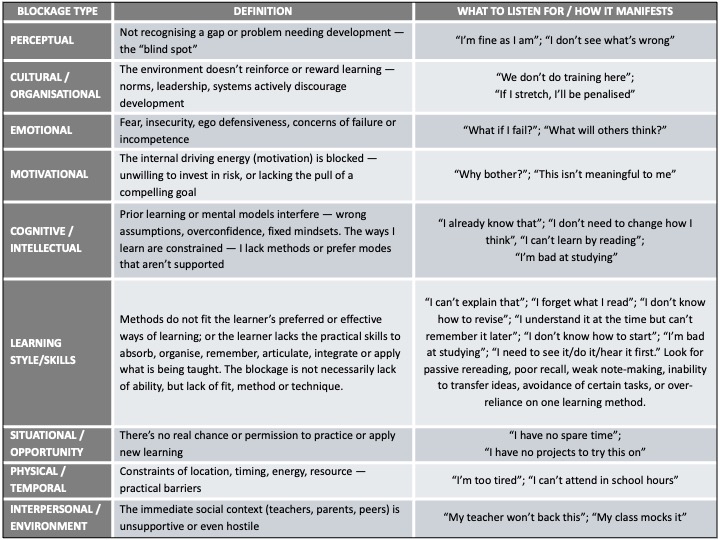
The important point is that the visible behaviour may be similar—poor work, low effort, distraction, withdrawal—but the causes can be completely different. And different causes require different interventions.
There is another complication. Some blocks are relatively easy to remove. If a student lacks a textbook, a suitable desk or enough time to complete an assignment, the problem may at least be identifiable and potentially soluble. But how quickly can we repair a broken relationship? Restore confidence? Change an unhealthy school culture? Rebuild a student’s belief that learning has meaning?
This is why, in our model, the most difficult blocks tend to be those involving relationships, motivation and culture. They concern not merely the mechanics of learning, but the learner’s internal energy and the social world in which that energy has to operate.
And this brings us to motivation. Motivation is one of the Nine Blocks, but it also runs through all the others. That is a crucial distinction. Although our forthcoming book focuses specifically on students, these Blocks to Learning do not mysteriously disappear when we leave school. Adults encounter them too — and nowhere more obviously than in the workplace. A manager who cannot see the need to change may have a Perceptual Block; an employee afraid of making mistakes may face an Emotional one; a team trapped by “the way we do things here” may be experiencing a Cultural/Organisational Block; while poor relationships with colleagues or managers can create perhaps the most stubborn block of all. Indeed, organisations spend enormous sums on training and development while sometimes overlooking the more fundamental question: what is preventing the learning from taking hold? The language may change as we grow older, but the Blocks remain remarkably familiar.
We often talk about motivation as though somebody either “has it” or does not. But motivation is much more dynamic than that. A student may be highly motivated in one context and apparently lethargic in another. They may spend three hours mastering something nobody has asked them to learn, yet resist twenty minutes of prescribed homework. Why?
One possibility is that the first activity feeds something important within them and the second does not. This is where Motivational Youth Maps (MYM) becomes especially useful. Instead of treating motivation as one undifferentiated quantity, the Map identifies nine different motivational drivers.
Some students are strongly driven by belonging and relationships. Some by achievement and recognition. Others by autonomy, creativity, mastery, material reward, influence, security or purpose. And suddenly “Why won’t this student work?” becomes a much more interesting question. Perhaps the student is not devoid of motivation at all. Perhaps their motivational energy is being blocked, starved or pointed somewhere else.
A strongly autonomous student may resist excessive prescription. A creative student may wilt in an environment where every answer and every method is predetermined. A student strongly motivated by purpose may struggle with work whose relevance has never been explained.
The answer is not to abandon standards or allow students simply to do whatever they like. Motivation is not an excuse for avoiding rigour. The challenge is to create motivational fit: to find ways of connecting necessary learning with the energies that already exist within the learner.
There is another mistake adults often make when a young person’s motivation has collapsed. We ask for too much.
“From now on, you need to work harder.”
“You’ve got to turn this around.”
“You need to become more organised.”
These may be perfectly reasonable objectives, but to a depleted student they can sound enormous. A better starting point can be what we call the small-win path. Don’t demand transformation. Create movement. One completed paragraph. Ten minutes of uninterrupted revision. One question asked in class. One piece of homework submitted on time. One decision made independently.
Small actions matter because they begin to restore agency: I can do something. And once movement begins, motivational energy can begin to return. But here, too, precision matters. The right small win for one student may not be the right one for another. One may need to experience competence; another independence; another recognition; another connection; another meaning. The intervention becomes personal rather than generic.
Schools measure many things extraordinarily well: attendance, behaviour, test results, examination grades. But some of the most important forces affecting those outcomes are much harder to see. Motivation is one of them. So are the blocks that suppress it.
That is why Mapping Motivation for Students is built around a practical question: how can teachers, parents, coaches and students themselves develop a better language for understanding what is actually happening when learning falters?
Sometimes the answer will be a skills gap.
Sometimes it will be environment.
Sometimes it will be confidence, relationships, opportunity or perception.
And sometimes the most important discovery will be that the supposedly “unmotivated” student has plenty of motivational energy after all.
It is simply not being reached. That changes the conversation. Instead of:
“Why won’t you try harder?”
we can begin asking:
“What is blocking you—and what might release the energy to move forwards?”
That is a very different question. And it may produce a very different learner.
Mapping Motivation for Students, by James Sale and Qinghua Liu, is forthcoming from Routledge (2027).
If you are a teacher, school leader, parent, coach or educational professional and would like to know more about the Motivational Youth Map — and how it can help identify what energises individual students and what may be getting in the way of their learning — please contact me. I would be delighted to tell you more.

